A Universe Thought to Be Slowing Down
By 1998, the textbook consensus was clear: gravity must be decelerating the expansion of the universe. The Big Bang had launched the cosmos outward; gravity was pulling it back. The only open question was whether there was enough matter to halt and reverse the expansion, or whether the universe would expand forever, but always more slowly.
Almost no physicist took the cosmological constant seriously. A remark attributed to Einstein via George Gamow had branded it his greatest blunder. The prevailing assumption was Λ = 0, a Minkowski universe governed by the Poincaré group.
Two rival teams set out to measure the deceleration precisely, to settle the question of how much dark matter the universe contained. Neither team expected what they found.
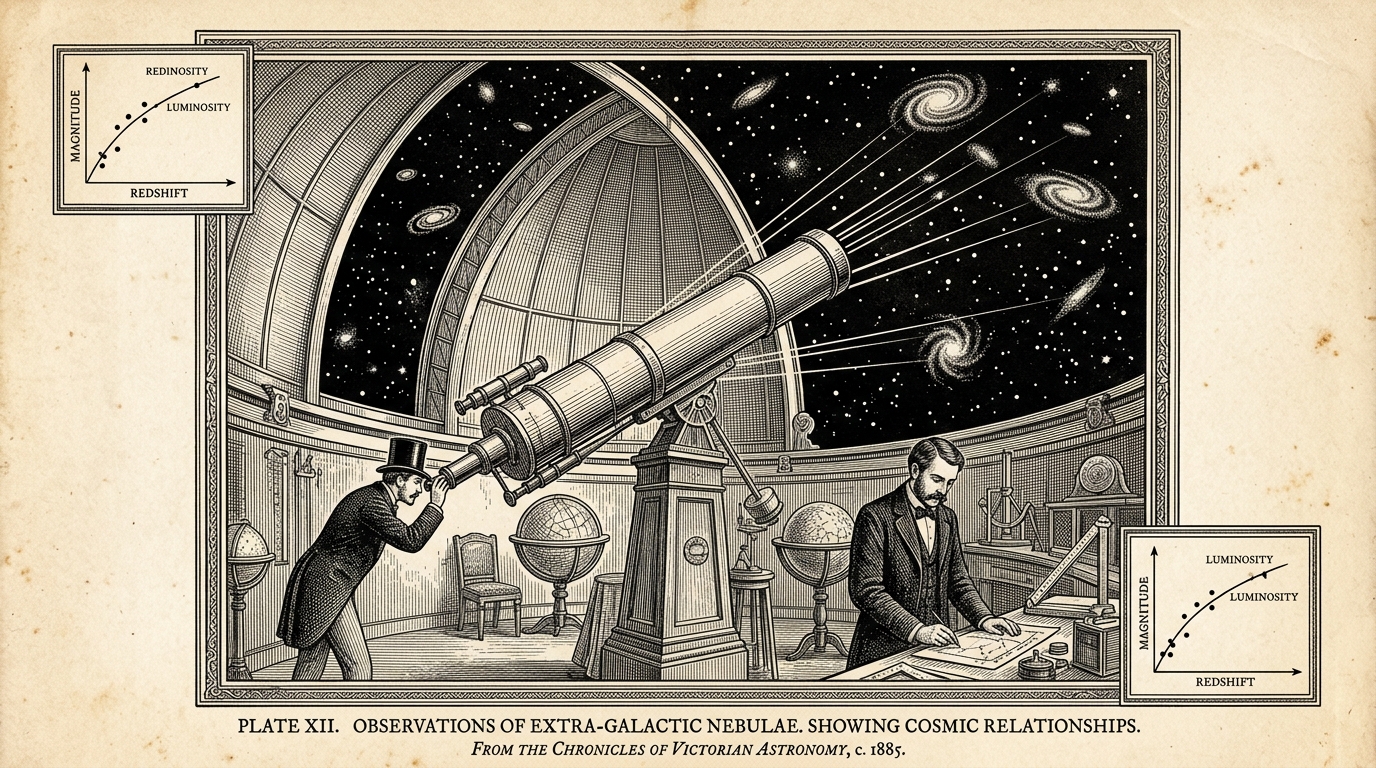
Engraving after the observatory surveys of 1997–1999. Two rival teams, thousands of observations.
The Standard Candle Strategy
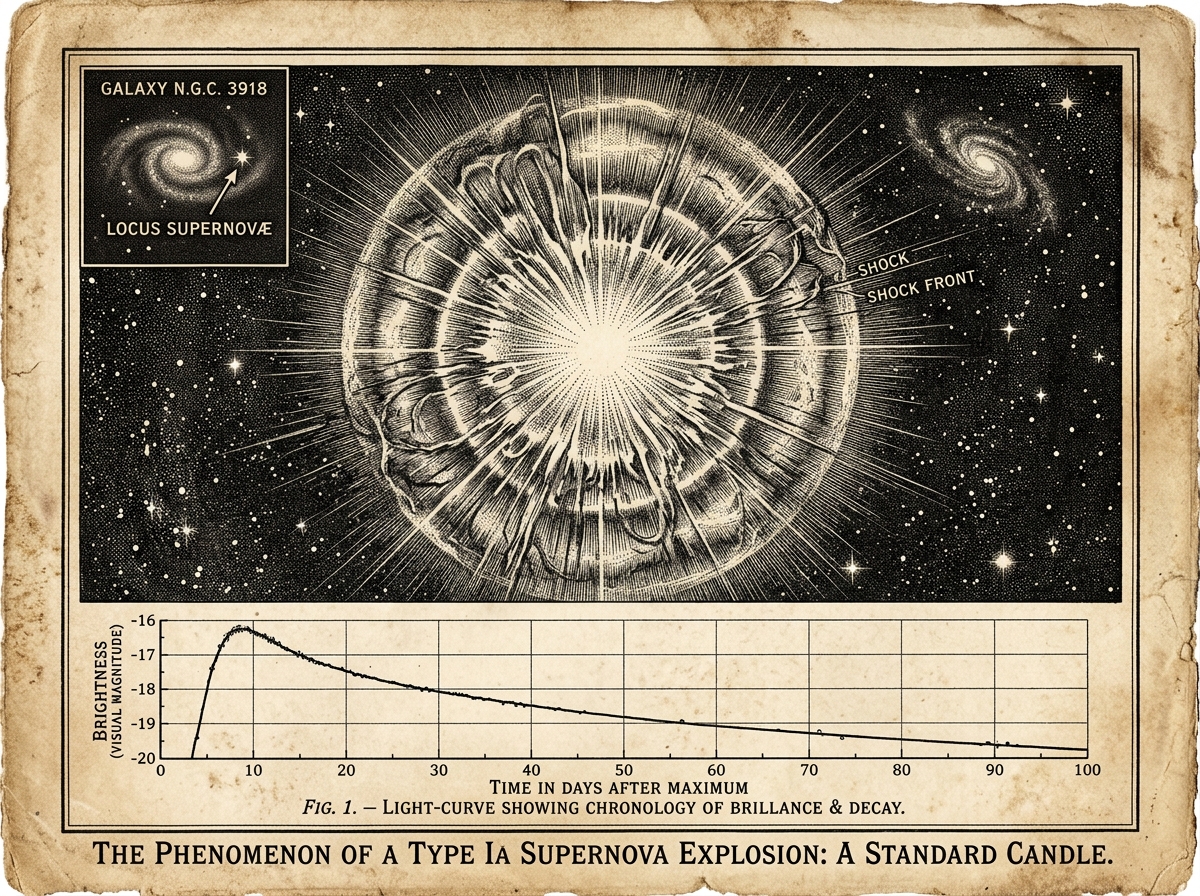
A Type Ia supernova, each one an identical explosion, an astronomers' ruler across cosmic distances.
Both teams exploited a remarkable property of Type Ia supernovae: white dwarf stars that explode at a precise mass threshold produce nearly identical intrinsic brightnesses. A brighter-looking supernova is simply closer; a dimmer one is farther away.
Using a refinement discovered by Mark Phillips, that brighter supernovae fade more slowly, both teams could calibrate each explosion to a standard luminosity and extract precise distances across billions of light years. Combined with the redshift of the host galaxy, this gave a direct measurement of how the expansion rate had changed over cosmic time.
Image thousands of galaxies near new Moon, batch-discover a dozen new supernovae
Re-image 3 weeks later, measure peak brightness and light-curve decline rate
Apply Phillips calibration, standardise each SN Ia to a common luminosity
Compare luminosity distance to redshift, read off expansion history
Two Teams. One Astonishing Answer.
Saul Perlmutter
Lawrence Berkeley National Laboratory · UC Berkeley
Perlmutter's team pioneered the "supernova on demand" method, scheduling telescope time around new Moons to reliably discover supernovae in batches. They assembled a dataset of 42 high-redshift Type Ia supernovae spanning redshifts z = 0.18 to 0.83, calibrated against 18 nearby supernovae from Chile's Calán/Tololo survey.
The 1998-1999 supernova surveys showed that the universe is accelerating, strongly inconsistent with a flat, matter-only (Λ = 0) cosmology. In the standard ΛCDM model this is described by a positive cosmological constant.
Perlmutter et al., Astrophys. J. 517:565–586, 1999
Brian Schmidt & Adam Riess
Australian National University · Johns Hopkins University
Schmidt's team, with Riess as lead analyst, studied 16 high-redshift supernovae (0.16 ≤ z ≤ 0.62) alongside 34 nearby comparison supernovae. Their analysis showed the distant supernovae were, on average, 10–15% farther than expected, implying the expansion was not decelerating but actively accelerating.
"Different methods unanimously favor eternally expanding models with positive cosmological constant and a current acceleration of the expansion (q₀ < 0)."
Riess et al., Astron. J. 116:1009–1038, 1998
The Diagram That Rewrote Physics
The Hubble diagram plots each supernova's apparent brightness against its redshift. In a universe decelerating under gravity, distant supernovae should appear slightly brighter than in a coasting (Λ = 0) model; gravity would have slowed the galaxies that hosted them, making them look closer than simple redshift suggests.
Instead, the data showed the opposite: the high-redshift supernovae appeared dimmer than even an empty coasting universe predicted. Something was pushing them away faster. The curve that best fit the data required a positive Λ, an accelerating expansion.
Gerson Goldhaber of the SCP and Adam Riess of the HZT both noticed this unexpected dimming independently in 1997. Neither team trusted it at first. They tested for dust, systematic errors, sample biases. Every check returned the same answer. The universe was accelerating.
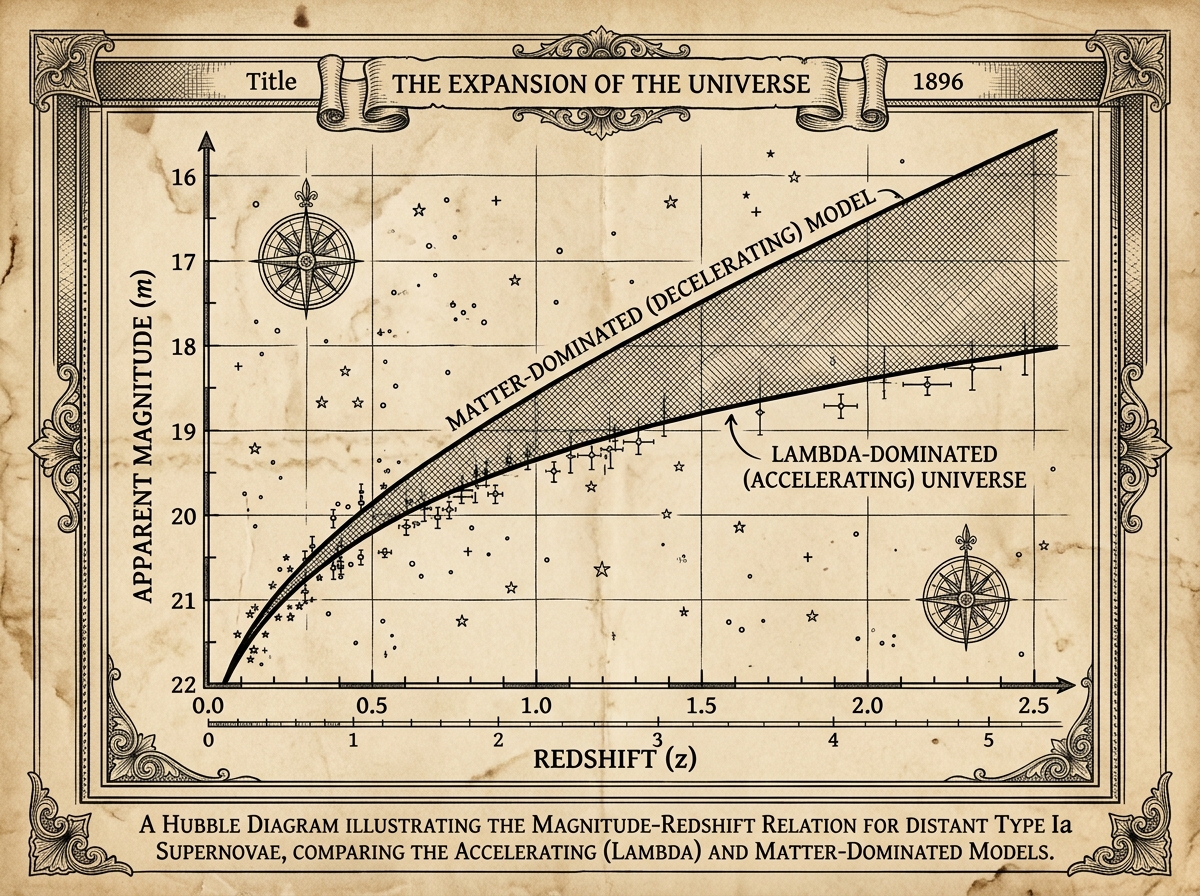
The Hubble diagram. The observed data points (scattered ink marks) fall above the decelerating model, they are dimmer, hence farther. The Λ > 0 curve fits the data. No other curve does.
Primary constrained result · Perlmutter 1999
0.8 ΩM − 0.6 ΩΛ ≈ −0.2 ± 0.1
The negative value demands ΩΛ > 0. The cosmological constant is nonzero. The universe is accelerating. Λ is real.
The Nobel Committee’s Verdict
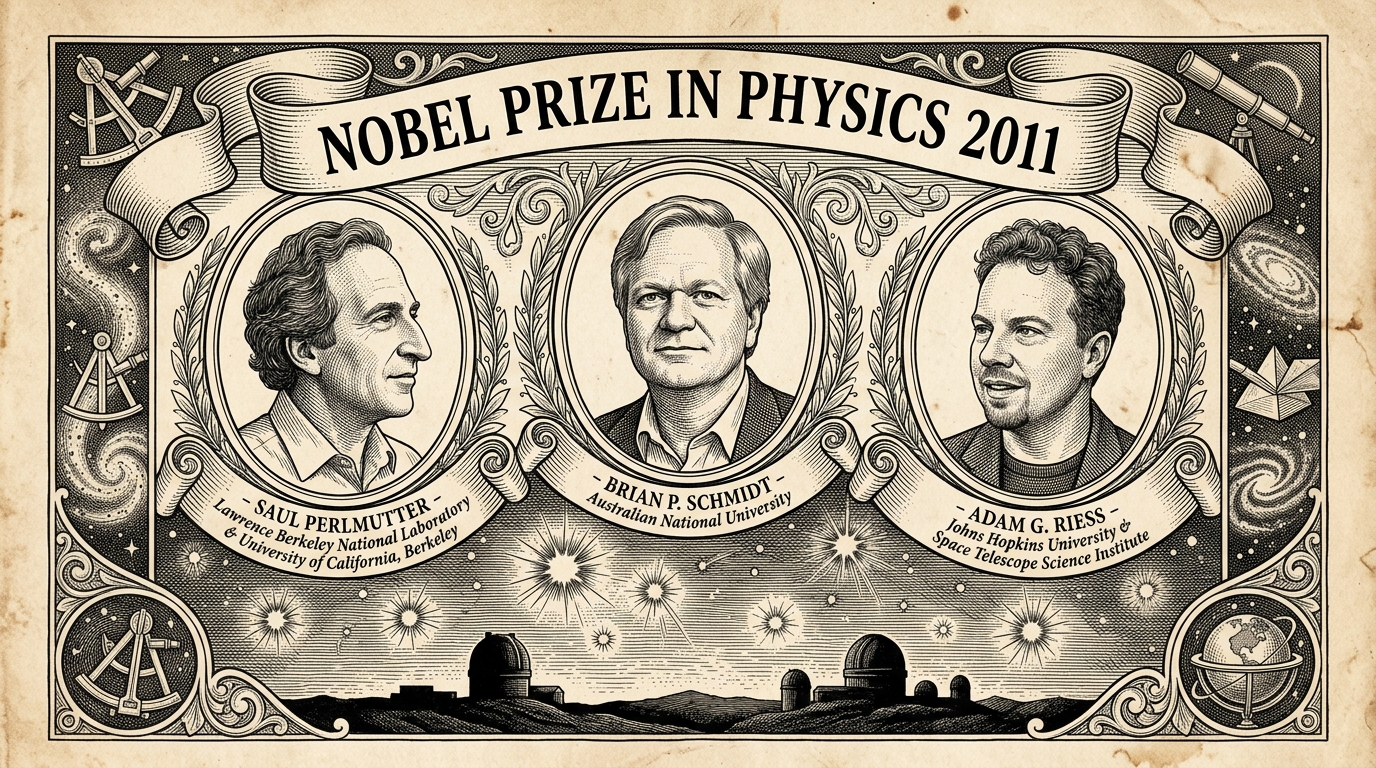
Perlmutter (½) · Schmidt & Riess (½ shared). Nobel Prize in Physics, October 2011.
“For the discovery of the accelerating expansion of the universe through observations of distant supernovae.”
Royal Swedish Academy of Sciences, 4 October 2011
The Nobel Committee's scientific background paper ended with a rhetorical flourish that encapsulated the mystery still before physics:
“Was Einstein’s ‘mistake’ of introducing the cosmological constant one more stroke of his genius?”
The discovery also won Science magazine’s Breakthrough of the Year for 1998, the first astronomical result to receive that honour. Independent confirmation came from CMB fluctuation measurements and baryon acoustic oscillations: the universe is 68% dark energy, 27% dark matter, 5% ordinary matter.
Saul Perlmutter
Lawrence Berkeley National Lab · UC Berkeley
Founded and led the Supernova Cosmology Project. Pioneered batch-discovery of distant supernovae. Analysed 42 SNe Ia to measure Ω and Λ.
Brian P. Schmidt
Mount Stromlo Observatory, Australian National University
Founded and led the High-Z Supernova Search Team. Co-authored the 1998 paper establishing accelerating expansion.
Adam G. Riess
Johns Hopkins University · Space Telescope Science Institute
Lead analyst of the HZT. First within the HZT to notice the unexpected dimming of high-z supernovae in 1997.
Our Universe’s Vacuum Geometry Is de Sitter (SO(4,1))
And almost all of modern physics assumes it is.
Every quantum field theory, including the Standard Model of particle physics, quantum electrodynamics, and the Higgs mechanism, is built on the Poincaré group: the symmetry group of Minkowski spacetime. Minkowski space is what you get when Λ = 0. It is perfectly flat, perfectly static in its geometry.
A universe with positive Λ is not Minkowski. It is de Sitter space, with a profoundly different symmetry group: SO(4,1), not the Poincaré group. The Poincaré group remains an excellent local approximation at laboratory and galactic scales, where Λ is negligible, but the fundamental vacuum symmetry of our universe is de Sitter.
The relationship between the two groups is exact: the Poincaré group is the contraction of the de Sitter group in the limit Λ → 0. This is analogous to how the Galilean group emerges from special relativity when c → ∞. Poincaré is a good approximation locally, where Λ is negligible, but it is not the fundamental symmetry of our universe.
This has profound consequences. Ordinary spacetime translations, the symmetry from which energy and momentum conservation are derived, are not exact symmetries in de Sitter space. The correct representations of quantum particles, the correct conserved charges, and the correct vacuum structure may need to be reconsidered for the de Sitter group, not the Poincaré group.
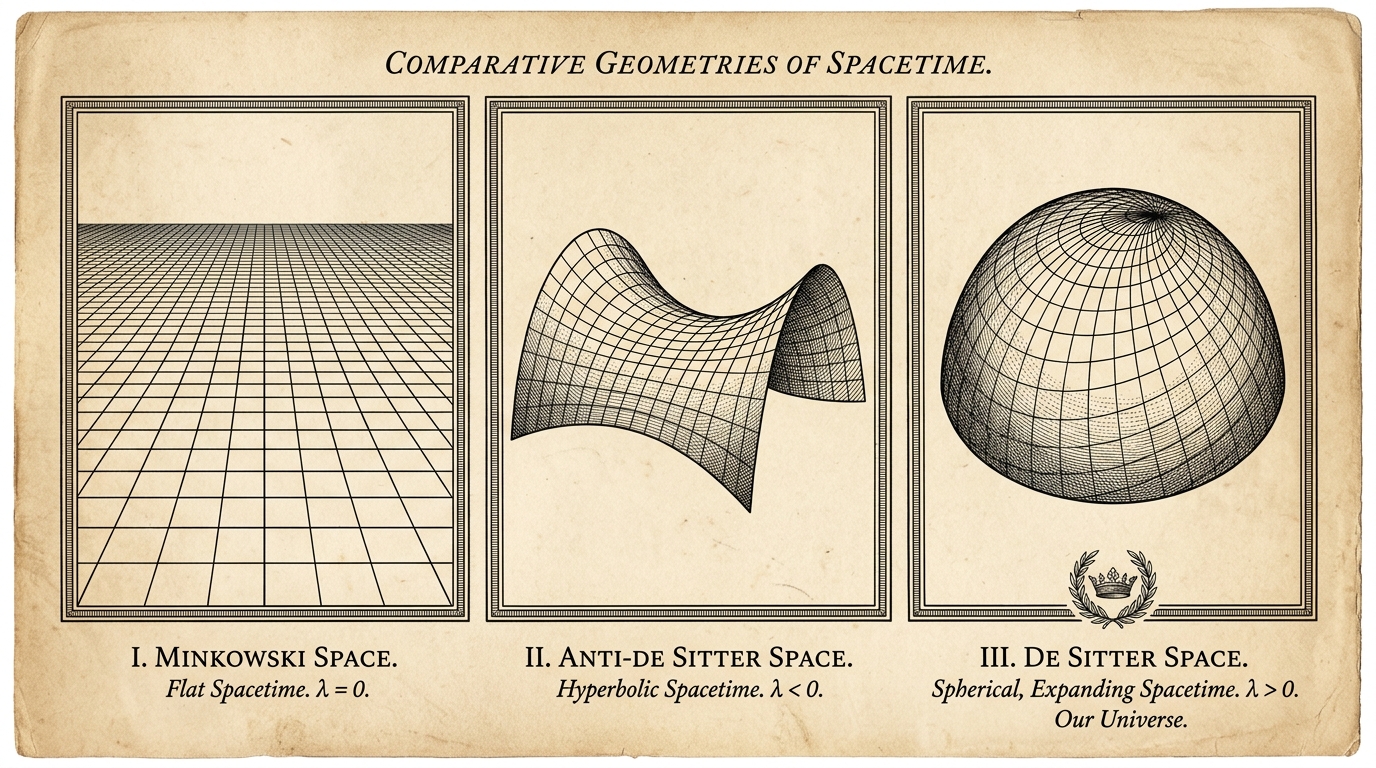
The three possible geometries. Our universe occupies the right-hand case: de Sitter space, Λ > 0.
The Poincaré group is not wrong. It is a limiting approximation, valid when Λ is negligibly small at laboratory scales. But it is not the fundamental symmetry of our universe, just as Newtonian mechanics is not wrong, merely a limit of special relativity.
The correct vacuum / asymptotic large-scale symmetry of our universe is SO(4,1). Quantum field theory on de Sitter space remains an active frontier.
The First Derivation of a Positive Λ
The 1998 and 1999 supernova results were observational. They told us Λ is positive, but they could not say why. The question of why Λ must be positive, and cannot be zero or negative, remained unanswered for a further 27 years.
The paper The Cosmological Constant Is Positive (Intelligent Internet, April 2026) provides the first purely algebraic derivation. The argument turns on the Killing form of the spacetime algebra, a diagnostic rooted in Wilhelm Killing’s 1888 work and developed centrally by Cartan to classify Lie algebras. Applied to the translation generators of general relativity, it yields a sign of 6Λ. For this to be consistent with Einstein’s founding relativity principle, read as a prohibition on external structure, Λ must be strictly positive.
This is the first derivation of a positive cosmological constant from first principles. It confirms what Perlmutter, Schmidt, and Riess found observationally. It also confirms that the correct vacuum / asymptotic large-scale symmetry of our spacetime is de Sitter (SO(4,1)), not Poincaré. The standard model of physics, built on the Poincaré group, is an approximation valid only in the limit Λ → 0. The full symmetry of nature is SO(4,1).
Riess et al. 1998 and Perlmutter et al. 1999 show the universe is accelerating. Λ > 0 at high confidence.
Riess 1998 · Perlmutter 1999
Nobel Prize in Physics. CMB and baryon acoustic oscillation measurements independently confirm ΩΛ ≈ 0.68.
Nobel Committee 2011
Λ > 0 is proved from the Killing form of the spacetime algebra and Einstein's founding relativity principle. First principles.
Mostaque, Intelligent Internet, April 2026
The ~120-Order-of-Magnitude Problem
Quantum field theory predicts the vacuum energy density, the contribution of virtual particles to Λ, to be vastly larger than the observed value. This is a discrepancy of roughly 120 orders of magnitude, the largest known failure of agreement between theory and observation in all of science.
This discrepancy, known as the cosmological constant problem, is one of the deepest open questions in theoretical physics. This paper, which proves Λ must be positive, does not resolve the magnitude problem, but it resolves the sign problem: Λ is positive, not zero, and not negative. That narrows the problem considerably.
Nobel Committee, 2011
“What is the source of the dark energy that drives the accelerating expansion? Or was Einstein’s ‘mistake’ of introducing the cosmological constant one more stroke of his genius?”