Chapter III

Three Options.
One Survivor.

Once you read Einstein’s founding relativity principle precisely enough, the algebra of spacetime turns out to have exactly three possible forms, one for each possible sign of the cosmological constant. Only one is both self-contained and internally scaled.

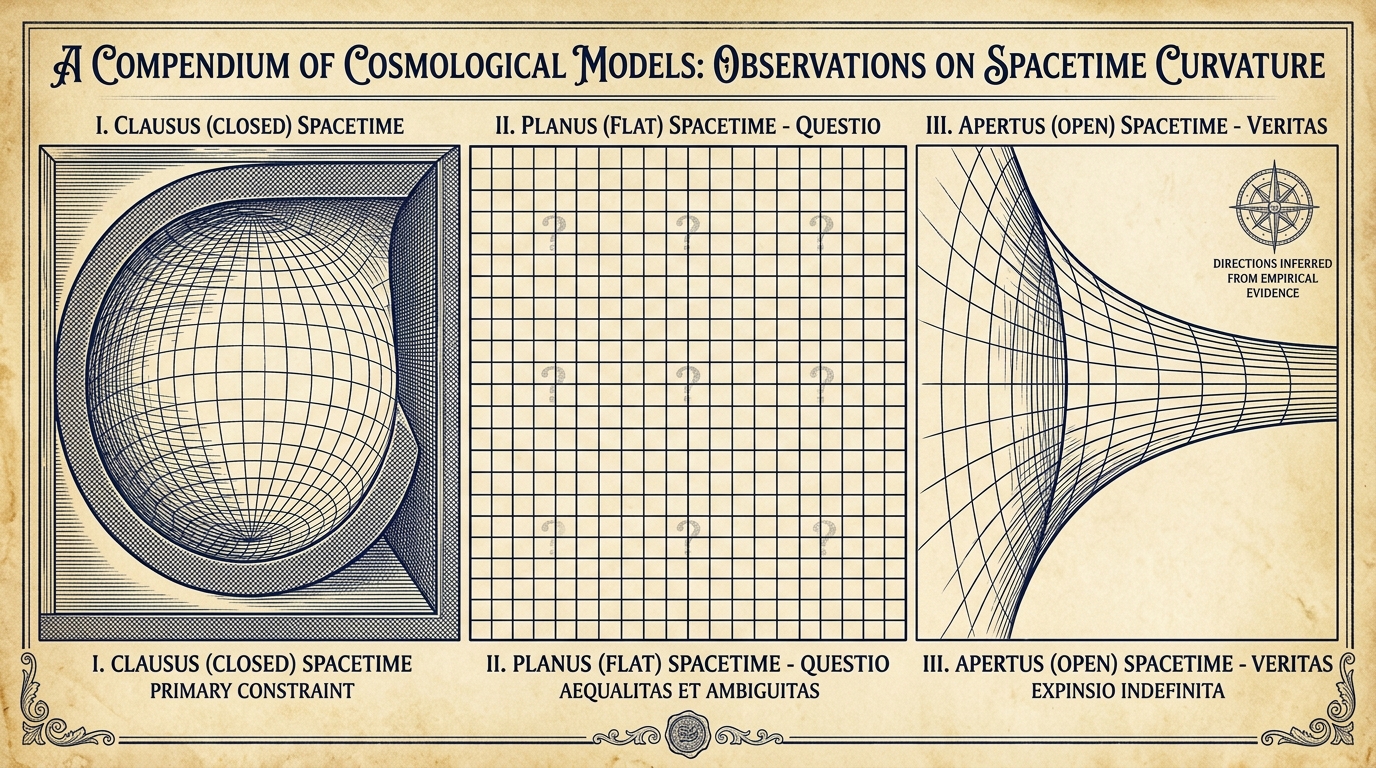
Three spacetime curvature diagrams showing Anti-de Sitter, Minkowski, and de Sitter

Three possible spacetime geometries. Left: walled, constrained (Λ < 0). Centre: flat, undetermined (Λ = 0). Right: open, self-contained (Λ > 0).

Λ < 0
Anti-de Sitter Space
A universe with walls
timelike boundary

Timelike boundary walls at the edge, information flows inward

What happens

When Λ is negative, the resulting spacetime, called Anti-de Sitter space, has a boundary at the edge: a timelike wall. Information can flow in from this wall. The physics isn’t self-contained. It needs boundary conditions that the relativity principle does not provide.

B(Pμ, Pν) = 6Λ ημν

The Killing form is negative on translations, so the algebra sees the boundary.

✕ Not self-contained under relativity. Eliminated.
Λ = 0
Minkowski Space
A universe without a ruler
?scale unknown

Clean flat grid, but the scale bar is missing

What happens

When Λ is zero, the algebra can determine the shape of spacetime but not its scale; it knows what the metric looks like but not how big it is. The ruler has to be supplied from outside. That’s exactly what the strong reading forbids. The algebra goes blind on the translations.

B(Pμ, Pν) = 6Λ ημν = 0

When Λ = 0 the Killing form vanishes on translations. The algebra can’t see them. The scale is undetermined.

✕ Needs an external ruler. Eliminated.
Λ > 0
de Sitter Space
A universe that carries its own ruler
L = 1/√Λ

Open, expanding, self-contained, the curvature radius emerges from within

What happens

When Λ is positive, the algebra’s diagnostic registers a positive value on the translations. The curvature radius L = 1/√Λ is set by the algebra itself, with no outside input needed. The universe is globally hyperbolic: you can specify the state of the whole universe on a single time-slice and predict everything else. Self-contained. Every internal requirement satisfied.

B(Pμ, Pν) = 6Λ ημν

L = 1/√Λ

The Killing form is positive on translations. The algebra knows its own scale.

✓ Survives Every Requirement

The three candidates

PropertyΛ < 0Λ = 0Λ > 0
Killing form on P₀Non-zeroZeroNon-zero
Algebra typeAnti-de Sitter (AdS)Poincaré (flat)de Sitter (dS)
Curvature radius L1/√|Λ|None1/√Λ
Metric determined?NoNoYes
Globally hyperbolic?NoYesYes
Boundary conditions needed?YesYes (external scale required)No
Self-contained under relativity?NoNoYes
Built-in scale from within?YesNoYes
All requirements satisfied?NoNoYES

“We finally infer that boundary conditions in spatial infinity fall away altogether...”

Albert Einstein, Kosmologische Betrachtungen, 1917
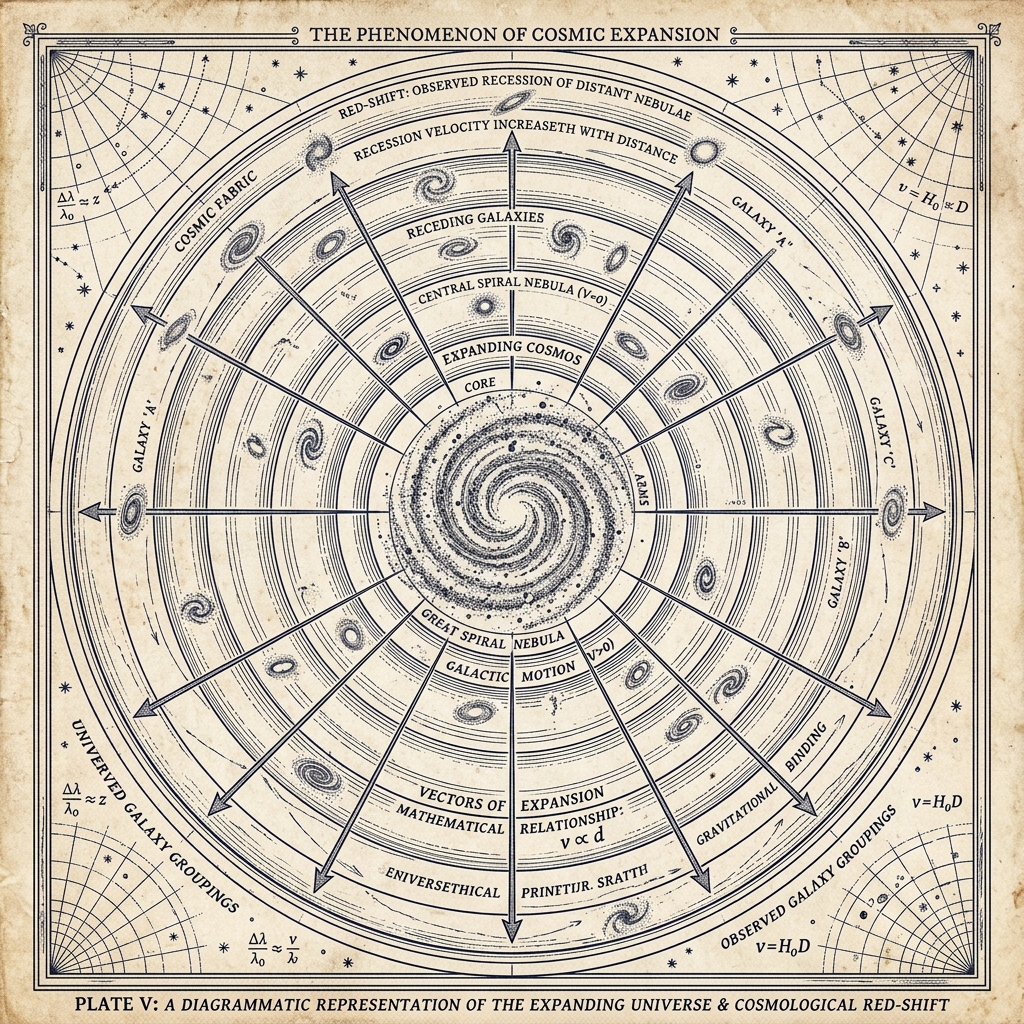
Victorian astronomical diagram showing an expanding universe

The Universe That Cannot Help But Grow

de Sitter space, the universe with Λ > 0, is not just “allowed” to expand. It is fundamentally, algebraically required to. The curvature radius L = 1/√Λ is determined internally. The expansion rate H = √(Λ/3) follows. These are not facts you add to the theory. They emerge from the theory itself.

Einstein’s 1917 introduction of Λ was not a patch or a fudge. It was the only self-consistent choice.